Object of the Month: March 2026
Share
The Green Man: an ever-present, ever-green figure
With the falling blossom and lighter evenings ushering in spring, this month's focus is a nature motif that has endured across centuries. This figure offers a quiet thread that has connected past and present through the changing seasons.
If you were to step in Selly Manor Museum today, and among the many carvings in our collection, you might notice a face peering out. With a playful grin crowned with leaves, this figure keeps a watchful eye. The Green Man is an enduring motif in folklore and has found its way, across the centuries, into many stone and wooden carvings. At Selly Manor Museum, the Green Man is present on two of our objects and is actually the face that appears on our logo. Why is this elusive figure so ever-present?
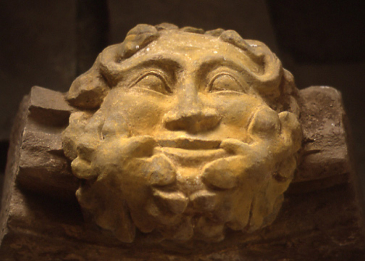
Image Above: Stone carving cheerful Green Man at Dore Abbey, Herefordshire surrounded by foliage (Source Wikipedia).
Origins and Symbolism
The Green Man’s origins (or should I say roots) are mysterious. Even his name is a relatively modern addition, first used by Lady Raglan in March 1938 in her article for the ‘Folklore’ Journal. Yet the figure dates back to at least mediaeval Europe, most frequently perched high in churches' stonework, though often is found on many domestic items like wooden chests. Some scholars have suggested the motif may pre-date Christianity and link it to pagan imagery of nature’s cycles.
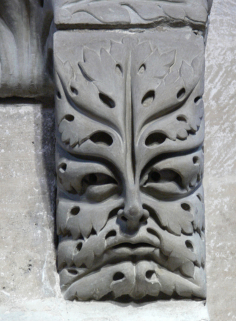
Image above: Watchful Green Man in Bamberg Cathedral, Germany from early 13th century (Source Wikipedia).
Early depictions often show figures crowned with foliage showing man and nature at peace. This form of Green Man is somewhat reminiscent of Dionysus, the Roman god of wine, revelry and the wild. Art Historians do suggest that the motif might be tied to late Roman art. By the 13th and 14th centuries, though, the figure grew more eerie and grotesque, often shown with vines spilling from the mouth, eyes and ears, the face wild and contorted, as if overwhelmed by nature itself. Painted with striking colours of red, green, black and gold, these wilder demonic iterations may reflect Christian apprehension towards ancient pagan customs. An embodiment of the untamed world beyond religious order.
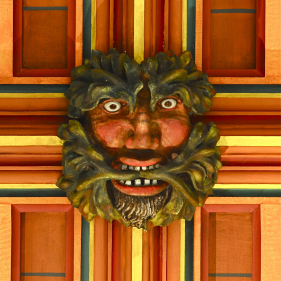
Image Above: Painted medieval grotesque Green Man with vines spilling out of his moth located in Rochester Cathedral, Kent (Source Wikipedia).
The Green Man also features in British folklore. Robin Hood is sometimes linked to him through his green attire and his home of Nottingham Forest. In the Arthurian legend, Sir Gawain and the Green Knight, the Green knight offers an opposing way to the structured, rule-bounded games of Authur’s court. Sir Gawain is challenged by the Green Knight and humbled as he is unable to kill his foe. The Green Knight teaches Gawain that bravery is not the ability to be unafraid and boastful, but rather to accept and face his fears. In the tale, Sir Gawain is made anew by his encounter with the Green Man, echoing the cycles of nature: the renewal of spring, life of summer and the death of winter.
The motif also stretches past British folklore as there was a known example in Iraq, a sculpted foliate head was discovered in the ruins of Hatra, dating to the 2nd century, showing cross-cultural significance. Much of what we know about the Green Man comes from Kathleen Basford’s photographic study, published in 1978, which documents countless examples.
Selly Manor’s Green Men
Our museum hosts the Laurence Cadbury collection, which includes two remarkable chests featuring this mysterious figure.
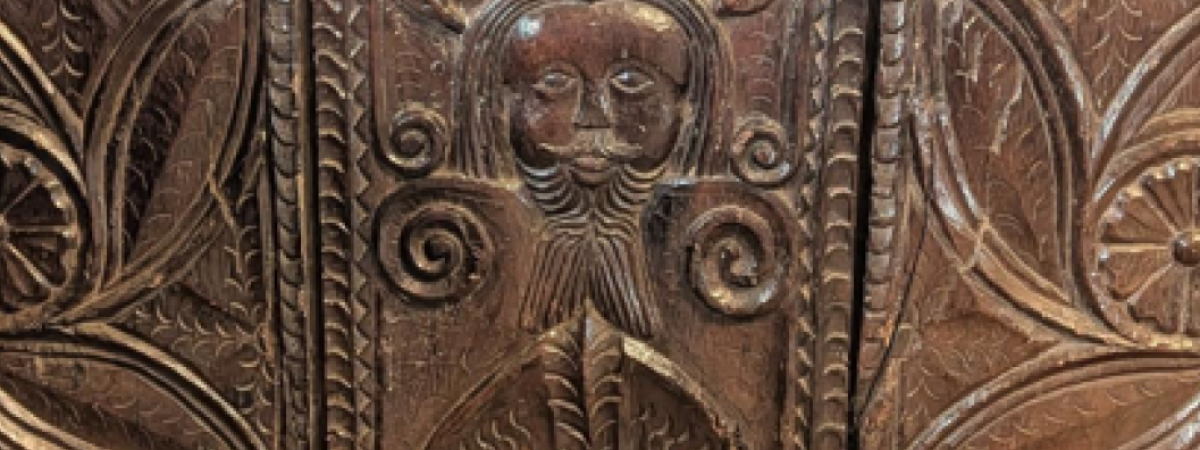
The first is the Grotesque Chest, brought by Laurence Cadbury from Straford-Upon-Avon, though its cravings link it to the West Country. The 16th century chest depicts a chaotic scene: playful monkeys, a goose chasing a fleeting man and wyverns. Nestled among the chaos is a Green Man, echoing similar carvings found in the South-West and one village in particular Crowcombe, Somerset. Interestingly, the chest is thought to be a marriage gift as it includes the Romanesque portraits of a man and woman in Yeoman dress. Thereby, speculatively linking the green man, in this context, to fertility and blessing of a new marriage. Its lively scenes make it one the most visually striking objects in our collection.
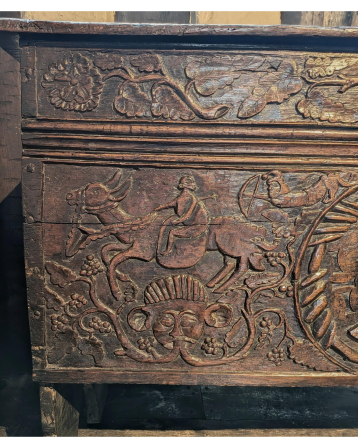
Image Above: The carving above is the one of the Green Man on our grotesque chest with vines spilling from his mouth embedded in the chaotic scene.
The second object is one of our Breton Chests, originating from Brittany in France. Dating from around 16th - 17th centuries, the chest features an unusual carving of a bearded figure with leaves protruding from his hair. In many ways, this is a friendlier looking Green Man. Surrounding him are late Gothic Catherine wheel motifs, gouge carvings, and delicate scratchwork. Similar to our grotesque chest, Breton Chests were often used to store values like linen and given as wedding gifts, reflecting the detailed craftsmanship. Though featuring different decorative styles and Green Men, these pieces of furniture show how ever-present this figure was across countries and centuries. The Green Man from this chest is the one that inspired the Selly Manor Museum logo, with the leafy welcoming figure greeting all who visit.
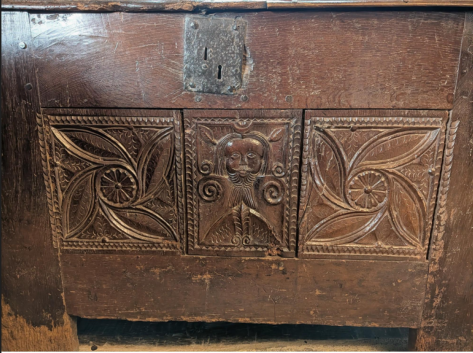
Image Above: The cheerful Green Man carving on our Breton Chest in the Solar.
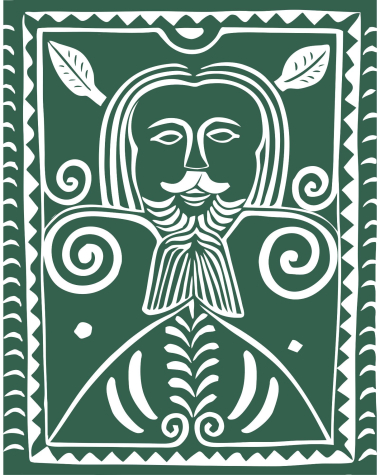
Image Above: Selly Manor Museum's logo!
The Green Man Today
The Green Man continues to resonate today. Across Britain, there are many ‘Green Man’ pubs with his leafy visage on the pub signs. A reminder of his ties to revelry and the wild. His association with festivities also extends to May Day Celebrations, when traditions of dancing around the maypole and crowning the “Jack-in-the-Green” to beckon the arrival of spring. Today, this connection continues with events like the Green Man Festival in Wales, a vibrant celebration of music, art and the natural world. It feels particularly fitting that Birmingham is home to an impressive Green Man statue in Digbeth, quietly demonstrating to passers-by that nature has always been part of the city’s story. We are the greenest city in Europe after all.
Whether carved in a Tudor chest, on a museum logo, perched in a church, or painted on pub signs, the Green Man is a living, ever-green figure within Britain’s cultural imagination. You never know where you might stumble upon him!
Written by Megan Ward, Museum Assistant
Interested to find out more about this mysterious figure, please watch BBC Culture's documentary - The surprising roots of the mysterious Green Man - BBC Culture