The Builders of Selly Manor
Share
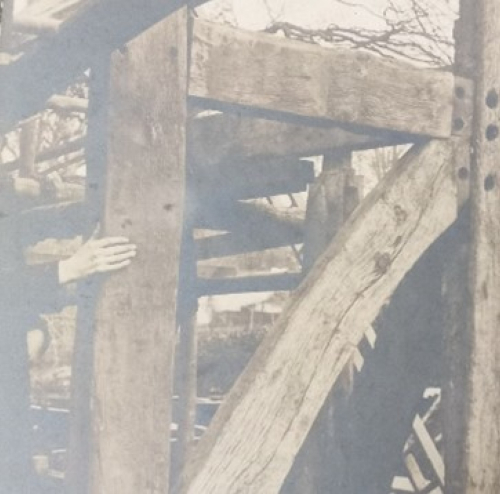
Image above: A fleeting glimpse of the hands that rebuilt Selly Manor.
This blog post is one in a series about photographs and other material in the Selly Manor archives, mainly dealing with the disassembly and reconstruction of Selly Manor and Minworth Greaves in Bournville.
The architect of the project was W. Alexander Harvey, who was also responsible for many of the buildings in Bournville, and the contractor was a firm called Mitchell, of Tamworth. It appears that Mr Mitchell used at least some of his own workers because of the way he later wrote about one of them, but virtually nothing is otherwise known about the workmen. Yet strangely we can see them, because Harvey took a series of pictures of the disassembly and reconstruction of the building. The workmen appear in the background of some pictures, not the focus of interest but they are present and essential. In only one or two do they face the camera and give any impression of a personality. Otherwise, we see them getting on with their work, wearing three-piece suits and flat caps on a building site.
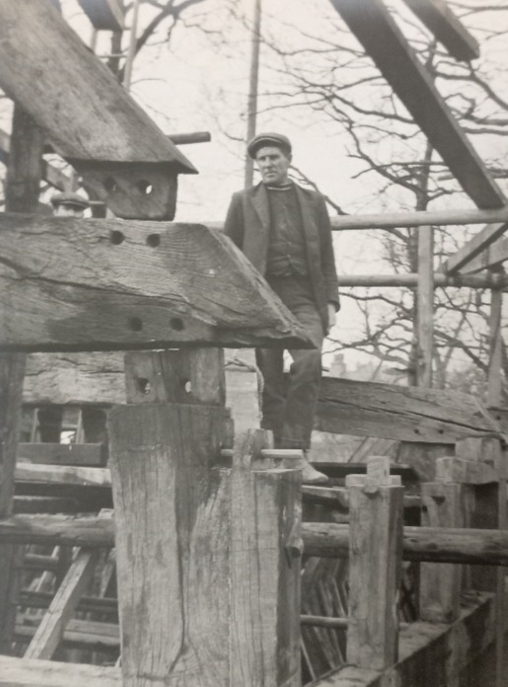
Image above: Builder kitted out with flat cap and suit!
The pictures show their working conditions and the tools of their trades: hand tools only. In one touching photograph we just see a hand on a beam and nothing else of its owner. These are tantalising glimpses of the men who took apart Selly Manor and rebuilt it.
Yet we do know the name of one of them, who worked on both Selly Manor and on disassembling Minworth Greaves. Only his surname is given in the archives - Statham - and he is constantly described as 'the old man'. He was married which would have stopped him being called up during the early years of the First World War, and perhaps his age excluded him from other war work, leaving him able to continue this project. It was particularly important that he stayed as archival records suggest the project was largely dependent on him. In a letter dated October 17th 1915, while Selly Manor was being rebuilt in Bournville and Minworth Greaves had been purchased, Laurence Cadbury wrote to George Cadbury about the pressures of war and having Mr Statham on hand to do the work:
'With regard to [Minworth Greaves] I quite see thy point that if things are not done now, they are not likely to be done at all. [...]
'The trouble with our old Mr Statham, of course, is that once we lose him we may not be able to get him again so I rather think we might keep him but allow no one else on the job. I don't think we should do any work on the place except what he does.
'I think, first of all, he should finish the house itself entirely, then do all the paving round. [...] Then, I think he should pull down carefully, number, and repair a little, the framework of the Minworth building.'
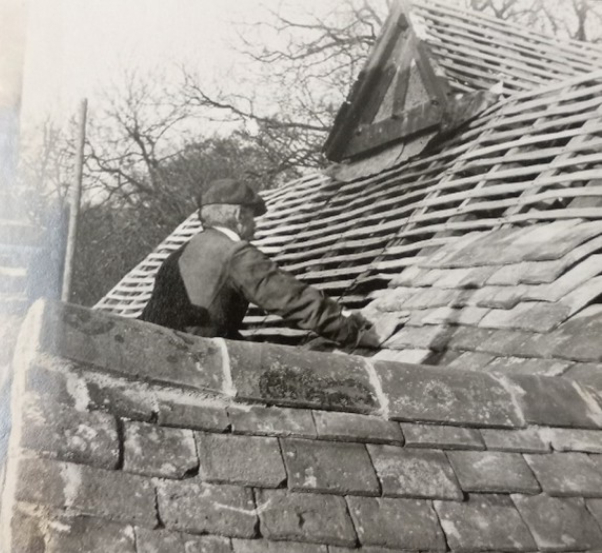
Image above: In looking through the photographs that contain builders, this one stood out as the man pictured looks to be older than the other builders. Could this be Statham, the foreman, checking on the progress of the roof?
George Cadbury replied to his son's letter, above, on October 21st 1915:
'I will let Mr Harvey have a copy of thy letter that deals with the old house, and tell him to carry out thy suggestion as to pulling down and numbering and repairing a little of the framework of the Minworth building; this, the old man could be going on with, but I agree with thee it would not be wise for us to erect it at present; this would leep him going, and his heart is in the place. He would like to see thee back to look after it. He is a loyal old fellow, though so rough and uncouth.'
While these letters give the impression that Mr Statham virtually did all the work single-handedly, we know from photographs that there were usually several workers, and in a letter dated 9th June 1960 from Graham Wicks to Leonard J Cadbury we read:
'The builders were H C Mitchell & Son of Aldergate, Tamworth, a firm who specialised in restoration work. They put Statham, a craftsman of considerable experience in charge under the regular supervision of Mr Charles Mitchell and, of course, Harvey. I cannot give you the exact number of men employed but they were not more than four or five at any time. The work was carried out on a cost basis, plus a percentage to cover the Principal's time, supervision, office overheads, insurance, etc.'
Given that Mr Statham is the only one of the builders whose name we know, and he obviously had a crucial role in saving the old farmhouse from Bournbrook and Minworth Greaves, it is perhaps fitting that we also know about his death. On 24th August 1916 Mr Mitchell wrote to W. Alexander Harvey:
'Dear Mr Harvey
'Statham died on midnight of Sat, and was buried yesterday afternoon. I cannot tell you what a blow this is to me. The week after I saw you at Grimshaw Hall he started for me again - in fact, he never really left me. We have been repairing an Elizabethan house and he was in the midst of it. He caught a chill last week. On Friday night I saw him in bed and he was full of his work here, and apparently just as usual, except for a very bad cold. Pneumonia set in and he died very suddenly without the least knowledge that he was so ill. He had never had an illness and when it came he refused to admit it.
'He was a man I simply cannot replace. Apart from his loyalty and excellence as a workman, he was a most delightful man.
'His widow lives at "Marshall's Buildings, Church St, Tamworth" and I think a few lines from yourself would be a great comfort to her.
'Yours respectfully
'H. Chas Mitchell'
Below are some of the pictures we have of the builders who worked on Selly Manor. We don't know whether any of them is Mr Statham. Do you recognise anyone from the family album?
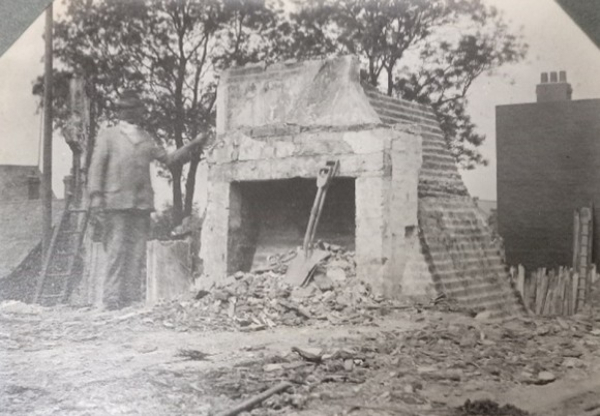
Image above: One of the many fireplaces in Selly Manor being repaired and made ready for the rebuild.
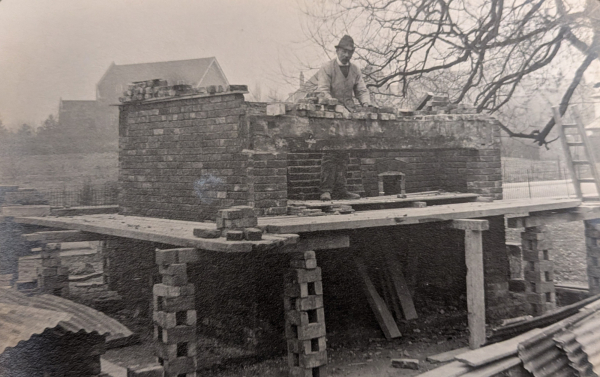
Image above: The builders in the photographs above might the same person as they have similar hats. Both shots give a glimpse into the skilled work undertake to restore the fireplaces.
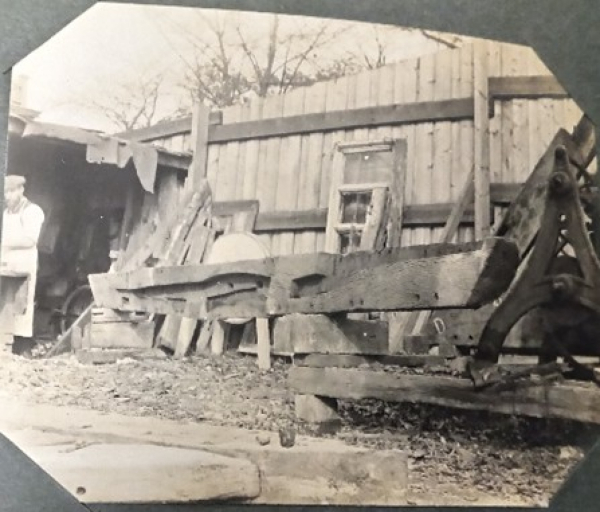
Image above: On the left edge of this photograph is one of the workmen responsible for the upkeep of the wooden beams.
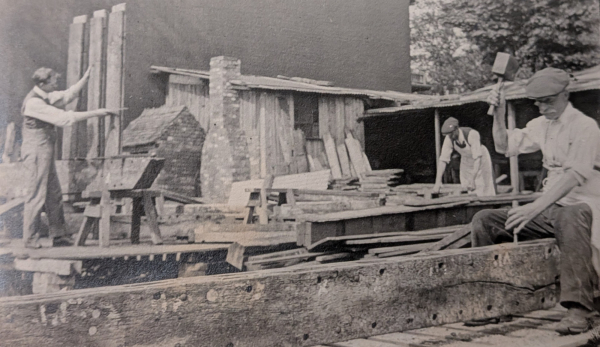
Image above: Three skilled workers can be seen working on the sizable beams in this photograph. This is a yard separate to the site. Interestingly, the man on the left seems to be measuring up the beams and is not wearing an apron. It is possible he could be the architect William Alexander Harvey. Whereas the other two men are undertaking key repair work.
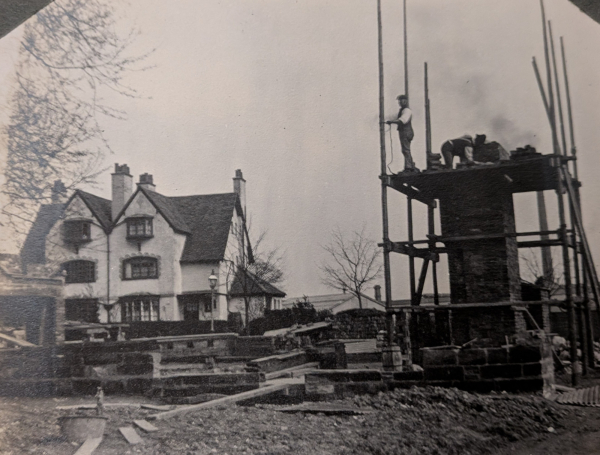
Image above: Health and Safety alongside hard hats were a distant idea to the builders who worked on Selly Manor. This photograph was taken in the early stages of the rebuild, and you can see two builders working on one of the chimneys. One of the early houses on Sycamore Road can be spotted behind.
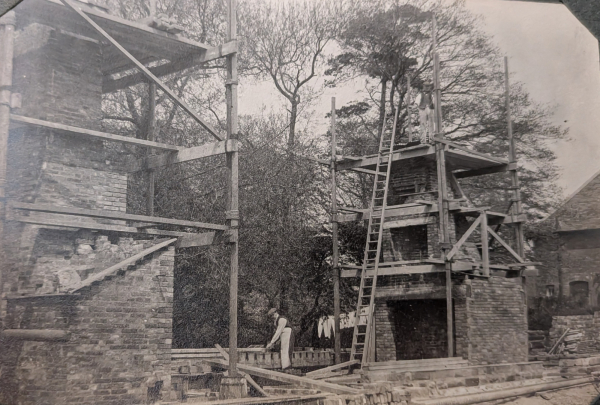
Image above: This incredible photograph frames one of the builders in the middle of two towering chimney pieces. What you may be able to make out behind him is a washing line with a collection of white fabric - possibly a collection of builder's aprons! There is another man who is looking down from the top of the scaffolding.
These photographs give us a glimpse into the men who re-built the Selly Manor Museum we know today. Hopefully, through this blog we might be able to identify a few and give them the credit they deserve.
Written by John Berry, Volunteer, & Megan Ward, Museum Assistant.
Source: Selly Manor Archives & Bournville Village Trust Archives