Object of the Month: August 2026
Share
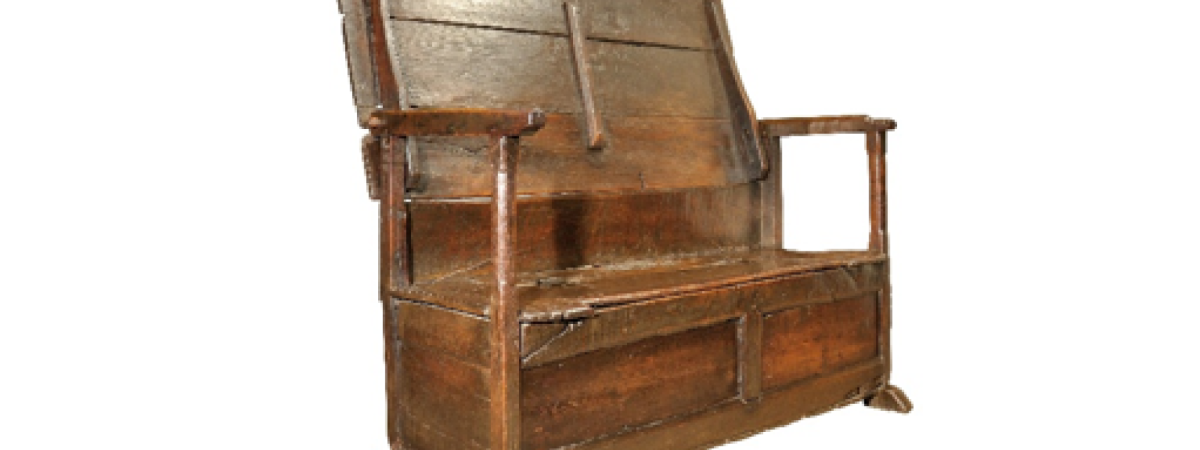
This month I will be focusing on two 18th century table settles, furniture items from our collection that have a very versatile use.
Produced in England between 1740 -1780, settle A is made from oak and pine wood. It can be found on display in the parlour against the back wall, currently in its ‘seat’ position. Settle B was also produced in England c.1740 but is made from oak and elm and was acquired by Selly Manor in 1910, when Laurence Cadbury purchased it in St Albans for only £5 (around £793 in today’s money)!
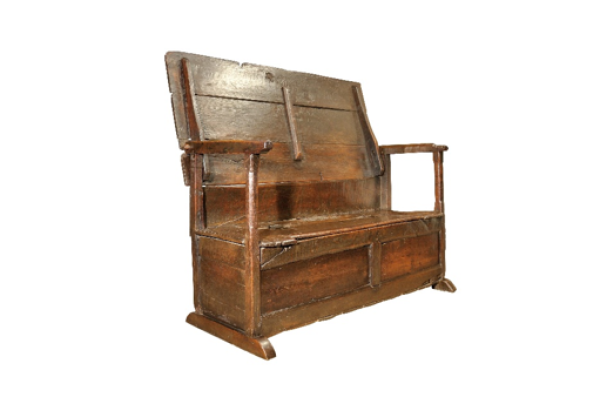
Table Settle A
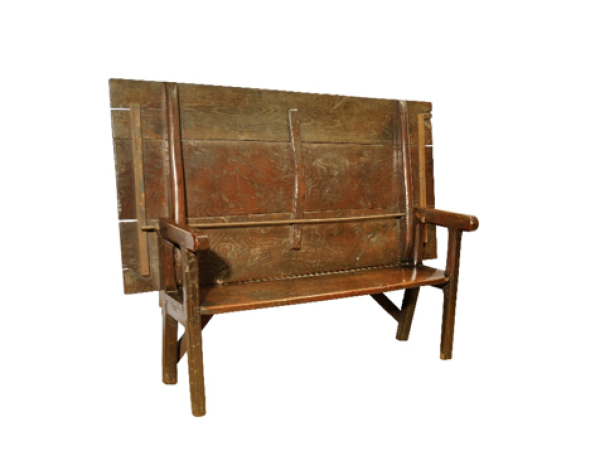
Table Settle B
The top panel of the settles can be vertically upright to act as a backrest for the seat, or they can be horizontally flat to serve as a tabletop. The panels can be easily moved by hinges that are attached to the armrests. The bottom section of settle A is a storage compartment that sits on sledge feet, with a lid that allows it to be used as a seat or bench.
Both settles show signs of wear and tear from centuries of use. In fact, table settle A has previously had its hinges, front panels and one foot replaced.
I have wondered why the object is called a settle, and some research has led me to find that the term ‘settle’ originates from the old English word ‘Setl’, which means a place to sit.
I really like this piece of furniture, because it is very practical in the way it can be used as a tabletop or counter space, as well as serving as a place to sit down. I also like the storage compartment, which could be used to store various items.
Having done a bit of research, I discovered that Settles can also be used as beds (Bed Settle), which were common in Ireland in the 1950s, with the first ones appearing in early 1600. They could be used to accommodate travelling workmen and craftsmen. The table settles were also common in Ireland. An antique settle can cost between £450 and £3,540 today. The varied price reflects on the different styles and eras they were made.
Particularly for poorer people with limited space, the settle was ideal because it served as a multifunctional piece of furniture that had various uses. This means it would have been perfect for storing items, thanks to the built-in storage compartments.
Written by Toby Kerry, Volunteer
Edited by Niamh Reid, Museum Assistant